Ship Unity builds without surprises.

Two products and hands-on optimization that keep build size, memory, and performance under control — from per-commit regression tracking, to evidence-first audits, to deep fixes. Built for Unity mobile teams shipping under release pressure.

Your build is 120 MB. Do you know why? Most teams don’t — they guess. I build the tools that measure what’s actually shipping, and I do the optimization work to bring it back down.
Monitor.
Audit. Fix.
One discipline, three layers — two of them productized, one hands-on.
Build Metrics
Track build size, build time, and regression history across every target you ship — so drift shows up on the commit that caused it, not in release week.
Release Vitals
Evidence-first audits of what’s actually in a build — size, memory, performance, build failures. Every finding labeled by how proven it is. Driven by your AI client, or by you.
Optimization
Hands-on engineering when you need the number to actually move — build size cut, startup sped up, memory and crashes brought under the line.
Two shipped tools
Real products in the niche — not a list of future promises.
Build Metrics
One place to watch build size, build time, and regression history across the targets your team actually ships.
- HISTORY — ANDROID / IOS / WEBGL / DESKTOP
- REGRESSION ALERTS BEFORE THE STORE
- CLOUD DASHBOARD WHEN THE TEAM NEEDS EVIDENCE
FIG. 2 — Build Metrics dashboardRelease Vitals
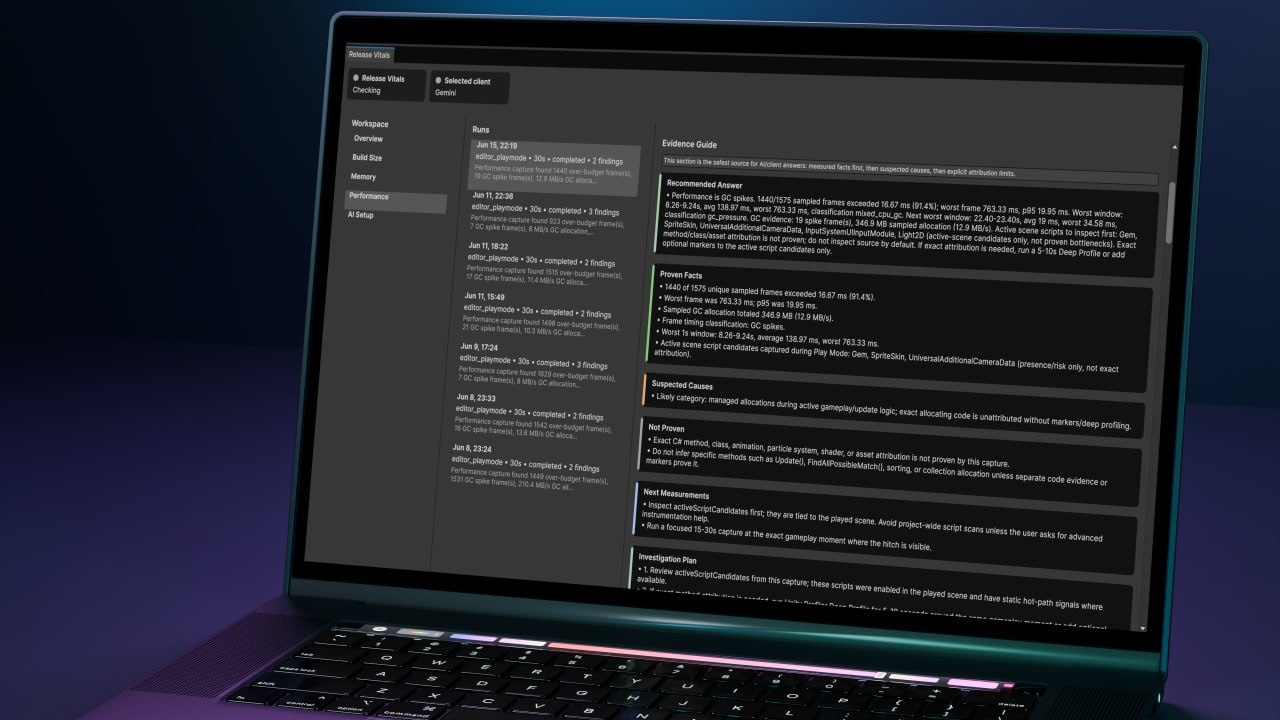
A local MCP server for Unity — evidence-first build, memory & performance audits your AI client runs (Claude, Codex, Gemini), or run yourself in the Editor. Read-only by default; nothing changes without your say-so.
- FIVE WORKFLOWS — SIZE · MEMORY · PERF · DIAGNOSTICS · BUILD-FAILURE
- EVIDENCE TIERS — PROVEN, NOT GUESSED
- LOCAL MCP — STDIO, NO CLOUD, NO TELEMETRY
FIG. 3 — Release Vitals, running an auditWhen the number
has to move.
Fixed-scope sprints. You bring a build; you get back a measured improvement + a baseline so it stays fixed.
Build-Size Reduction Sprint
Evidence-first audit — addressables, textures, audio, dead code, package usage verified against real scenes — then prioritized cuts and a re-measure. No guesswork deletion.
Startup & Performance Pass
Play-Mode + on-device capture to find worst-frame windows, GC pressure, and the real startup path — then targeted fixes on mid- and low-tier devices.
Memory & Crash Hardening
On-device memory capture → asset-level findings (audio decompression, oversized textures, Read/Write flags) tiered by build inclusion → fixes that clear the store crash threshold.
Measured outcomes,
not adjectives.
Real engagements, in numbers. Placeholders below — swap in your case studies.
Start with one audit.
The fastest way in: a Build-Size or Performance audit on one real build. You get a measured finding set and a clear fix plan — fixed price, no commitment beyond it.
Book an audit →